
Website Vehicle
Configuration Study
Overview
Client: BMW (client-sponsored research via Material+)
Study Type: Moderated qualitative exploratory research
Format: Remote and In-Person Moderated Sessions
Tools: Figma, Zoom, Google Sheets, Google Docs
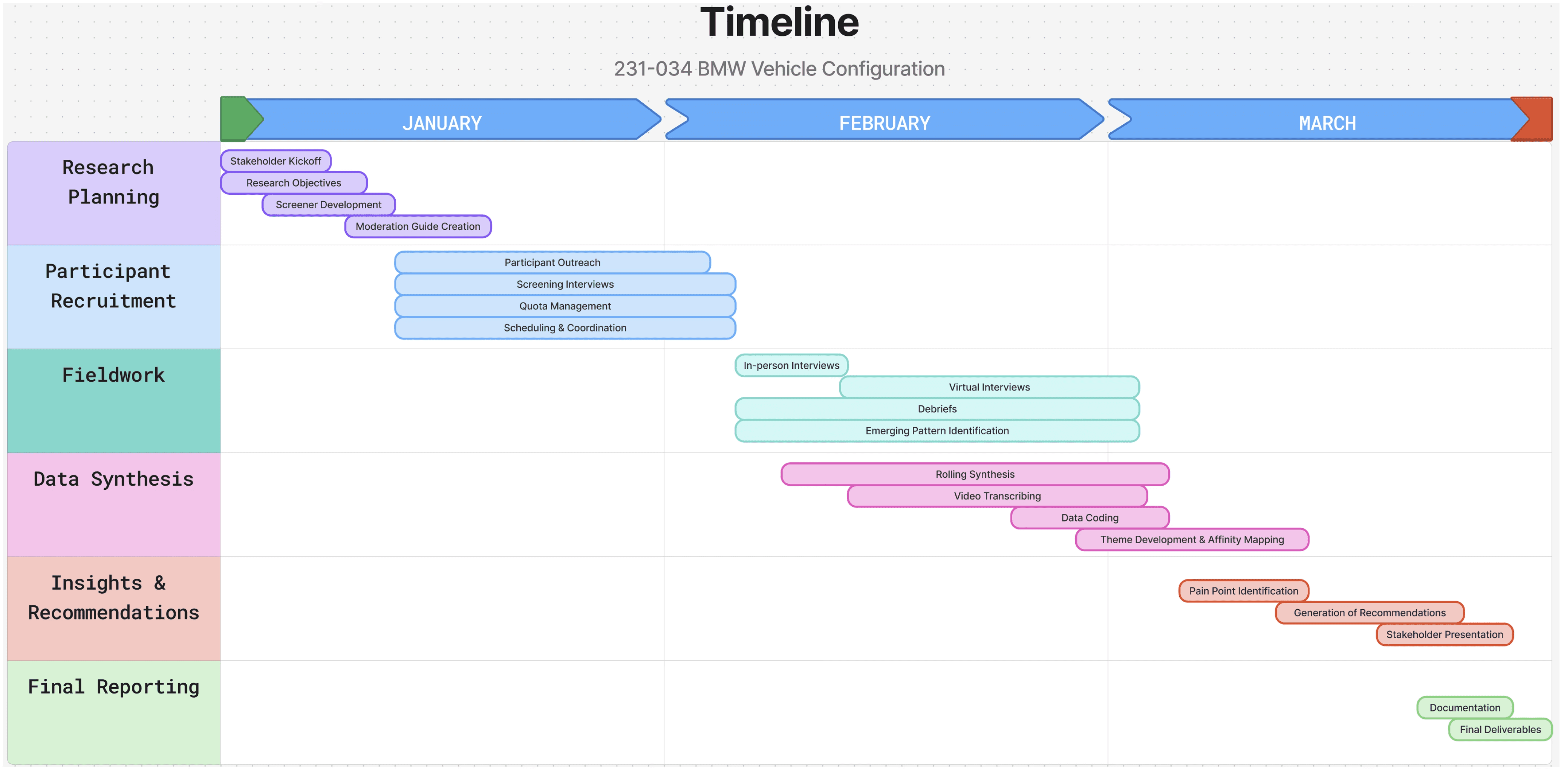
Dates: January 2024 – March 2024
Role: UX Research Moderator / Interviewer
Meaningful Data
%
Enjoyed experimenting with visual customization
%
Indicated interest in scheduling a test drive after configuration
%
Reported an increase in brand favorability after configuration
%
Felt more informed about BMW offerings after configuration
Research Question
How does the BMW website vehicle configurator influence buyer confidence during high-consideration vehicle purchases?
Problem Statement
As BMW expands its electric and customizable vehicle offerings, understanding how users evaluate, configure, and emotionally respond to current and proposed BMW vehicle options and offerings, is critical.
The website configurator is not just a selection tool — it shapes how buyers:
Interpret pricing and trade-offs
Perceive luxury and customization depth
Form confidence during high-consideration decision-making
This study examined whether potential customers could intuitively and confidently configure a BMW vehicle using a simulated digital experience, and how prior attitudes toward EVs and luxury vehicles influenced their decision-making behavior.
Research Objectives
This study aimed to understand:
How participants perceived BMW and EV vehicles prior to configuration
How they reasoned through feature and pricing trade-offs during customization
Which features or decisions drove preference, hesitation, or confusion
How customization depth influenced perceived luxury value
Where confidence increased or decreased throughout the experience
How digital exploration shaped readiness to visit a dealership
How behavioral patterns differed across ownership status and EV familiarity
These objectives focused on exploratory behavioral understanding, not performance measurement.
Research Approach
Methodology
Research Session Flow Diagram
Configuration
Interview
Debrief
Each 120-minute session consisted of two parts:
1. Configuration Session (≈ 60 minutes)
Participants created three different vehicle configurations of their choosing using BMW’s website configurator.
They selected:
Engine / powertrain
Exterior
Interior
Wheels
Packages and add-ons
Participants were instructed to think-aloud while configuring.
No structured tasks were assigned.
No success criteria was defined.
The experience was intentionally exploratory to reflect natural browsing and high-consideration decision-making behavior.
Sessions were moderated with neutral facilitation. No guidance was provided during configuration in order to observe organic reasoning patterns and trade-off evaluation.
2. In-Depth Interview (≈ 60 minutes)
The interview explored:
EV perceptions
BMW brand expectations
Pricing sensitivity and financial trade-offs
Customization priorities
Dealership and delivery expectations
Purchase confidence formation
This sequencing allowed participants’ attitudinal context to be directly compared with their observed configuration behavior, revealing how beliefs influenced real-time decision-making.
Participants & Recruiting Criteria
Participants were recruited to represent active vehicle buyers with decision-making authority.
Key criteria included:
Owns a vehicle purchased or leased new (2020 or newer)
Primary driver with full or partial purchase decision authority
50% BMW owners; 50% competitor-brand owners (Mercedes-Benz, Tesla, Lexus)
Non-rejectors of BMW (would consider BMW for next vehicle)
Age range: 18–70
No employment ties to the automotive industry
Analysis
Key Findings
1. Mismatched Feature Expectations within Packages
Observation:
Many participants expressed frustration when features they considered standard for a luxury vehicle (i.e heated seats, premium audio, or driver assistance features) required additional packages or higher trims.
Participants questioned why certain “luxury” features were not already included in the base model. This often shifted behavior from exploratory customization to value justification, causing participants to reassess upgrades, revisit trims, or remove features altogether.
This mismatch caused uncertainty and often slowed configuration momentum.
%
Expressed surprise that expected luxury features required upgrades
%
Verbally calculated “worth” of upgrades aloud
%
Seat heaters should come standard in every model. Why is this considered a premium feature?
“
”
If I’m already paying luxury pricing, I expect luxury basics.
“
”
It [base model] stopped feeling premium once I saw what was missing.
“
”
UX Interpretation:
Participants evaluated upgrades based on luxury expectations, not just price. When expected comfort, safety, and convenience features were excluded from the base model, perceived value and confidence decreased.
The issue was less about spending more, and more about whether the base experience felt appropriately premium.
Recommendation:
Better communicate the value of premium packages
Reduce late-stage discovery of missing expected features
Allow comparison between saved configuration versions
2. EV Attitudes Influenced Risk Sensitivity During Configuration
Observation:
Participants who were already comfortable with EVs explored freely and focused more on aesthetics and performance. Compared to the participants who expressed skepticism toward EVs during interviews demonstrated more cautious configuration behavior.
This included:
Hesitation toward committing to EV powertrain
Focused on practicality over aesthetics
More conservative feature selection
Delayed committing to powertrain
%
EV Skeptics
%
EV Comfortable
Explored performance customization
%
EV Skeptics
%
EV Comfortable
Compared EV pricing to gas models
%
EV Skeptics
%
EV Comfortable
“I kept second-guessing an electric vehicle because I couldn’t visualize how it would affect my everyday, real life.”
“
”
“I think once I understood the charging details better, I felt more comfortable exploring the electric models options.”
“
”
“The electric models technology truly impressed me, but I still have hesitations.”
“
”
UX Interpretation:
Pre-existing beliefs shaped interaction behavior.
For EV-skeptical users, configurator friction amplified uncertainty.
For EV-comfortable users, the configurator reinforced excitement and personalization.
The interface functioned as a confidence amplifier, both positively or negatively, depending on prior mindset.
Recommendation:
Integrate contextual EV reassurance within configuration flow
Provide accessible range and charging clarity
Surface cost-of-ownership information when relevant
3. Analytical Confidence Increased While Emotional Confidence Remained Incomplete
Observation:
After completing configuration, most participants reported feeling more informed about pricing and features. Although, digital clarity did not fully replace experiential validation.
Several still expressed hesitations relating to:
Interior material quality
Physical comfort
Real-world spatial perception
%
Felt digitally informed but emotionally uncertain
%
Average confidence in Purchasing Without Physical Visit
%
Wanted to physically see materials and feel interior comfort prior to a decision
“I know details like cost and features, more or less, but I still don’t know what it actually feels like to be in and drive the car.”
“
”
“The interior details sound great on paper, but I still need to see and feel it for myself before committing to a vehicle.”
“
”
UX Interpretation:
The configurator successfully supported analytical decision-making.
However, emotional commitment in luxury purchases requires sensory reassurance.
Without tactile validation, confidence plateaued rather than fully solidified.
Recommendation:
Simulate immersive interior visualization
Provide richer material previews
Offer seamless transition to dealership or test-drive scheduling
Ethical Considerations
Informed consent obtained
Participation voluntary
Data anonymized
Limitations
Simulated environment may differ from live purchasing context
Findings are directional, not predictive
Moderated environment may influence behavior
Focused on configuration experience, not post-purchase
Outcome & Impact
The study revealed that BMW’s configurator effectively supports creative exploration and personalization. Participants were able to engage with features, experiment with trims, and build vehicles aligned with their preferences.
However, confidence during high-consideration decision-making was most influenced by:
Transparency of financial and feature trade-offs
Early and clear communication of customization constraints
EV-related reassurance and clarity
Experiential validation gaps (e.g., materials, spatial perception)
Continuity between digital configuration and dealership engagement
While the tool enabled exploration, it required stronger decision-support mechanisms to sustain confidence during high-stakes trade-offs.
Addressing trade-off visibility, constraint clarity, immersion depth, and cross-channel continuity presents an opportunity to:
Increase decision confidence
Reduce hesitation cycles
Strengthen digital-to-dealership trust
Improve the overall high-consideration purchase experience
Reflection
This project strengthened my ability to:
Identify behavioral inflection points in high-stakes digital journeys and map where digital systems support or erode user confidence.
Analyze how interface structure shapes financial reasoning and connect emotional responses to decision architecture.
Synthesize exploratory behavioral patterns into structured UX issues and translate qualitative insights into actionable design strategy.